-
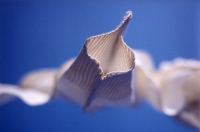
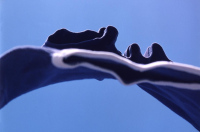
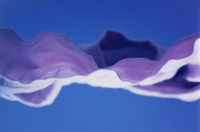
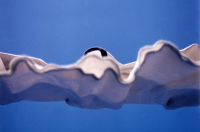
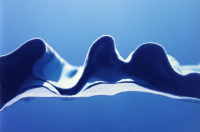
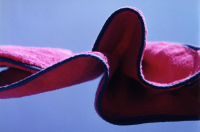
Satori (2002)
Satori 1. The Synopsis
Scene 1.
Van Gogh stands over the wooden kitchen table, trying to compose a fruit bowl and two vases. He takes the flowers out of one vase and places them in the fruit bowl. He cuts the stems in half and throws them in the trash. He constantly rearranges the objects. He closes the shutters. He opens the shutters and closes the curtains. He circles the table to find the right visual angle. He sits for a moment on a chair, tired and thoughtful. Silence. He rises from the chair and goes to his room. He brings a pair of brown shoes. He throws the fruit bowl and the vases out the window. He piles all his clothes into a small suitcase, pushes the table outside into the garden, and buries the suitcase underneath. He takes the shoes, locks the door, throws the key into the river, and moves to France! CUT
Jean Baudrillard writes in Photography and the Writing of Light that for an image to exist, “there must be a moment of birth, which can only occur when the noisy activities of the world are suspended and entirely annulled. The idea then is to replace the triumphant revelation (enlightenment) of meaning with a silent concealment (de-enlightenment) of objects and their appearance.” If one image says a thousand words, then we are captives of the words we generate by creating that image. Yet only the image itself can overturn its fundamental function—that of a thousand words. As Baudrillard adds, the subversive image discovers literalness in the object. Then we have a moment of “silence.” The eye faces the object—and nothing else. Whatever the photographer sees through the lens, and no words. Nothing interferes with the object itself; it is no longer a carrier of stories or meanings. Ideologies, aesthetics, and associations do not exist in that moment, whose duration is irrelevant. Because in that moment, we realize the autonomy of existence itself, the literalness of the object. It arises from an instantaneous observation where time gains depth and space gains duration. There, light is the proper field in which the object can exist on its own. Light—the way each image exists—becomes its absolute space. Composition is not what will give us a desired image, because the eye does not create but observes with absolute focus. Composition merely emerges from this need for clarity and quiet around the object.
Scene 2.
The Buddhist monk Tung San meditates, staring at a rock. He has been in this state for six years. CUT.
Aldous Huxley analyzes in The Art of Seeing the process of visual contact, noting that it is primarily a psychosomatic function, like walking or speaking. According to Huxley, seeing is divided into three subprocesses: sensation, selection, and perception. The first is the sensation of a field before our eyes (the sense of vision), the second is focusing on a particular point, and the last, perception, involves recognizing the field we sense and the focused point as physical objects in external space. In the process of seeing, the eye and nervous system are responsible for sensation, but the mind is what perceives. The spiritual process of perception relies on memory, and recalling an object helps us recognize it as itself. When we recover from a state of dizziness, initially seeing only blurry colors and then distinguishing separate objects, memory accelerates and facilitates this distinction. But how can this process be consciously reversed? Just as we repeat a word until it loses meaning, we can continually gaze at a point until we perceive it as form, as color, that is, as light. At the same time, the literalness of the point manifests in silence, and we no longer have any memory of it. Gradually, we arrive at abstraction. When this light is recorded, a subversive image emerges.
Scene 3.
The screen is split in two. Parallel action. On the left, Tung San rises and leaves. We follow his life. He becomes addicted to opium, participates in robberies and extortion, and becomes involved in flour smuggling. Six years later, he is murdered in a brothel in Delhi. On the right, Van Gogh is in a room surrounded by shoes and sketches depicting them in different positions and lighting. He places a pair of black boots in a dark corner. He makes different sketches. CUT.
Scene 4.
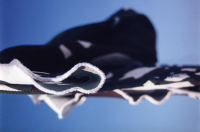
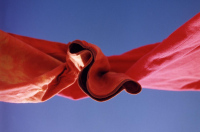
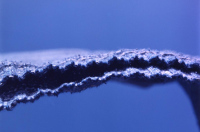
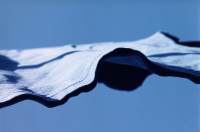
Alexis Vasilikos lies on the rooftop of his house under the laundry. CUT.
-Manolis Sporidis
From “Traces”, the Photosynkyria 2003 exhibition catalogue by the Thessaloniki Museum of Photography.